
2026-11-08
BPC-157 10 mg (BC10): From Synthesis to Batch Documentation
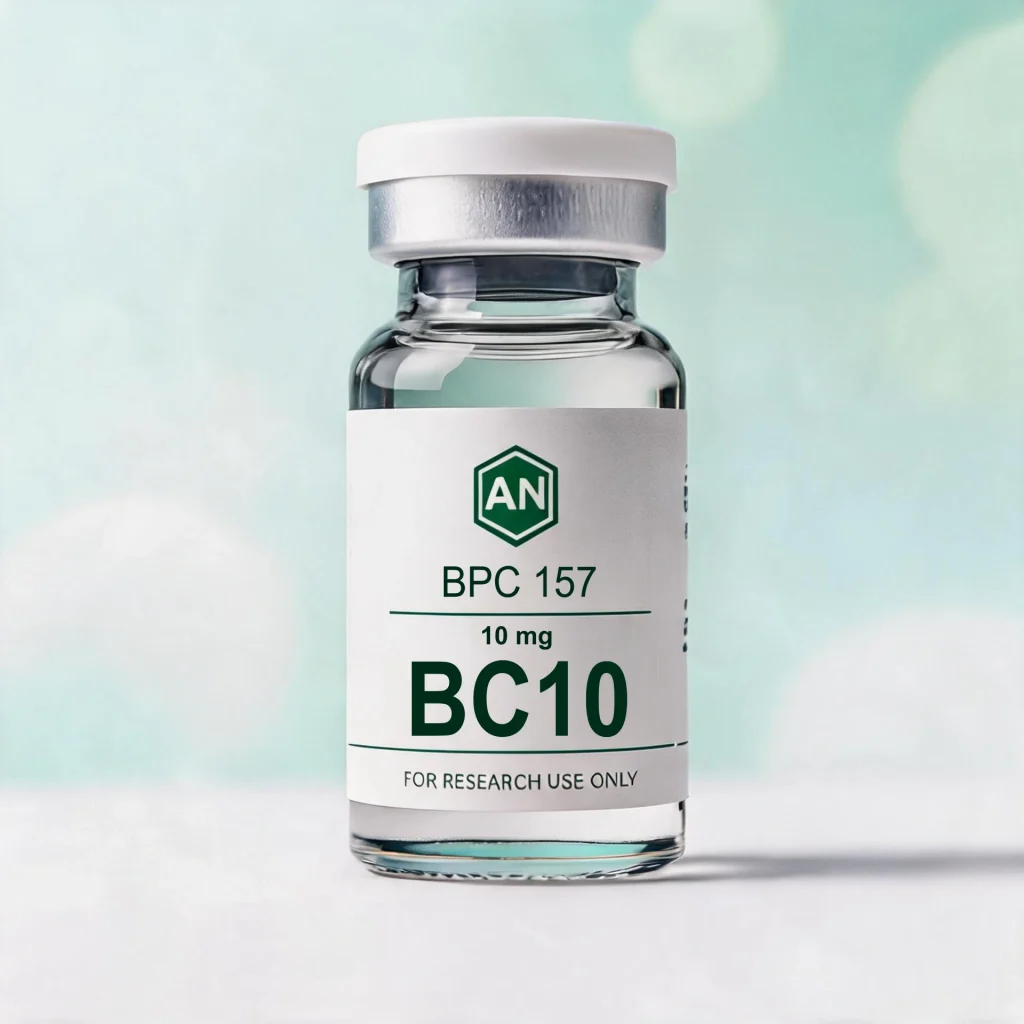
BPC-157 is one of the most requested materials in the AN-PEPTIDE catalog, and for good reason: it is chemically robust, easy to handle, and analytically well-behaved — qualities that make laboratory work simpler. In our catalog it is listed as item BC10 (BPC 157 10mg), supplied as ten 10 mg vials of lyophilized powder per pack. This guide walks through what the compound actually is, what the published literature has explored, how we recommend storing and reconstituting it, and what the paperwork in your shipment tells you.
A fifteen-residue peptide with an unusual origin
Most research peptides are designed on paper first. BPC-157 went the other way: it is a synthetic replica of a 15-amino-acid sequence found naturally in human gastric juice, where the parent compound was originally described in the scientific literature. That origin explains its two most practical properties. First, it is remarkably stable — a molecule that survives the gastric environment does not demand delicate handling by laboratory standards. Second, it is water-soluble and reliably reproducible by solid-phase peptide synthesis, so batch-to-batch consistency is straightforward to achieve and to verify.
The synthetic material is a single linear chain (molecular formula C62H98N16O22) with no modifications, which simplifies identity confirmation: the expected mass-spectrometry result is unambiguous, and any synthesis artifact shows up clearly in the HPLC trace.
What the published literature has explored
Published work on BPC-157 is unusually broad for a research compound. Animal and cell-culture studies in the literature have examined it across wound-closure and tissue-repair models, tendon and ligament injury models, vascular growth and angiogenesis assays, and gastrointestinal protection models — a range that reflects the parent compound’s origins. A second strand of work is purely analytical: because the peptide is stable and well-characterized, it is often used as a reference material when laboratories validate their own HPLC and MS workflows.
We deliberately keep this summary at the catalog level. Research teams should rely on the primary literature for model design, concentrations and endpoints — the material’s job is to be reproducible, not to promise outcomes.
The BC10 vial: specifications
| Specification | BC10 |
|---|---|
| Compound | BPC-157, synthetic 15-amino-acid linear peptide |
| CAS | 137525-51-0 |
| Molecular formula | C62H98N16O22 |
| Purity, published batch COA | 99.54% (HPLC) |
| Presentation | Lyophilized powder |
| Pack | 10 mg per vial, 10 vials per pack |
| Synthesis | Solid-phase peptide synthesis, in-house |
| Release testing | HPLC purity + mass-spectrometry identity |
Keeping the peptide intact: handling notes
BPC-157 tolerates ordinary laboratory logistics well, but three habits will keep it in the best possible condition. Store the sealed vials at −20 °C, dry and away from light. When a vial is opened, reconstitute only what you need — once a vial sees liquid, prepare single-use aliquots so the solution never cycles repeatedly through freezing and thawing. And use reconstituted material promptly: kept refrigerated, solutions hold up for roughly a day or two before quality becomes uncertain.
Sterile bacteriostatic water is the default reconstitution medium for most protocols. Sterile saline and mildly acidic buffered solutions are also compatible; whatever your method calls for, add liquid slowly down the vial wall and swirl gently rather than shaking.
What your batch documentation contains
Each BC10 order ships with a batch-specific Certificate of Analysis listing the item code and batch number, the analysis date, the measured HPLC purity for your batch, the MS identity result, and storage guidance for the format. The 99.54% figure shown above comes from the batch published on the product page; the COA in your box is the authoritative record for your own vials. If your institution needs external confirmation, third-party analytical reports can be requested against your batch number — for a line-by-line walkthrough of the certificate, see Third-Party COA Verification: What We Test and Why.
Other ways to buy BPC-157 in our catalog
Beyond BC10, the same compound is available as a 5 mg presentation (BC5), and in pre-mixed research blends with TB-500: BB10 (5 mg BPC + 5 mg TB-500) and BB20 (10 mg BPC + 10 mg TB-500). Every blend is manufactured and released under the same analytical regime, with its own batch COA.
Ordering
BC10 and the related items are in regular stock. Request a quote via the inquiry form on the BPC-157 product page or the contact page, or message our team on WhatsApp during business hours — including the item code, pack quantity and destination country gets you a quote fastest. In-stock orders leave our facility within 72 hours; international transit typically takes 7–15 working days, and MOQ is flexible for evaluation-scale programs.
All AN-PEPTIDE products, including BC10, are supplied for laboratory research use only. They are not drugs, foods, cosmetics or dietary supplements, and are not intended for human or veterinary use. Buyers are responsible for confirming that research use of these materials is permitted in their jurisdiction.